

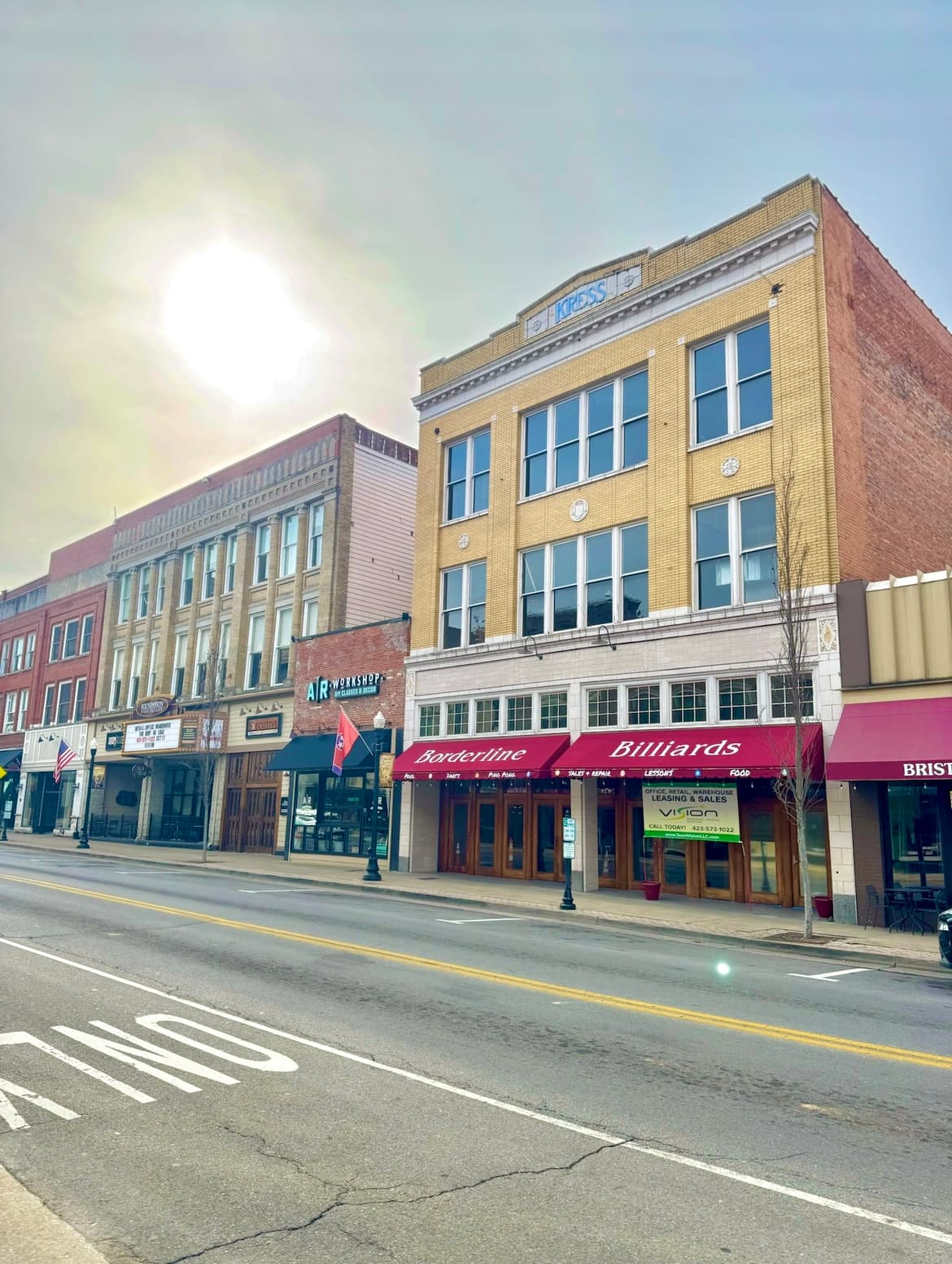
What Is Historic Adaptive Reuse — and Why Does It Matter?
Historic adaptive reuse is the practice of repurposing older or historic buildings for new commercial uses — rather than demolishing and rebuilding from scratch. Done well, it's one of the most economically and culturally powerful strategies in urban commercial real estate.
For downtown Bristol, TN (zip 37620, Sullivan County), adaptive reuse isn't just a development strategy. It's the mechanism through which a genuinely historic American city is reinventing itself for the 21st-century economy — without losing the architectural character that makes it worth investing in. Vision LLC has been at the center of this transformation for over two decades. As the largest private commercial property owner in downtown Bristol, we've executed more adaptive reuse conversions in this market than any other operator.
Bristol's Built Environment: A Hidden Asset
Bristol's downtown commercial core contains an extraordinary concentration of late 19th and early 20th century commercial architecture. Three- and four-story masonry buildings constructed between 1890 and 1940 — originally home to department stores, hotels, financial institutions and professional offices.
This building stock is both the challenge and the opportunity. Many of these structures spent decades underutilized as their original tenants vacated. Deferred maintenance accumulated. But the bones — massive masonry construction, high ceilings, generous floor plates, original hardwood and terrazzo — are extraordinary. When Vision LLC acquires a historic commercial building on State Street, we see past deferred maintenance to the underlying asset: irreplaceable architectural fabric and a downtown address that no suburban construction can replicate.
The Economics: Why Adaptive Reuse Pencils Out
Federal Historic Tax Credits (HTC): The Federal Historic Preservation Tax Incentives program provides a 20% tax credit on qualified rehabilitation expenditures for certified historic structures. For a $2 million rehabilitation project, that's $400,000 in direct federal tax credit.
Tennessee State Historic Tax Credit: Tennessee offers an additional state historic tax credit of up to 25% on qualifying rehabilitation projects. Combined with the federal credit, a well-structured Bristol adaptive reuse project can offset 40–45% of construction cost through tax incentives alone.
Demand for authentic space: The most important economic factor is the market. Businesses in 2025 are paying premium rents for authentic, characterful space in walkable downtown environments — choosing boutique historic buildings over suburban office parks at a rate that would have seemed implausible a decade ago.
The Neighborhood Context
Bristol's downtown sits adjacent to major cultural anchors: the Paramount Center for the Arts, the Birthplace of Country Music Museum, and the Pinnacle District. These anchors create a context where commercial real estate investment makes sense. Tenants want to be in a neighborhood that has a story, that has energy, that draws people for reasons beyond pure commercial function.
Development Partnerships: Working with Vision LLC
If you own a historic commercial building in downtown Bristol or the surrounding Sullivan County corridor, Vision LLC is actively interested in partnership conversations. We bring deep experience in historic tax credit underwriting, established relationships with Tennessee preservation offices, in-house construction management expertise, and knowledge of the Bristol leasing market.
Call 423-573-1022 or email leasing@teamvisionllc.com to start a confidential development conversation.